Ay, que es un alto rendimiento
The Spanish Treasury Thursday paid the highest yield on a 10-year
government bond at auction since the inception of the euro but garnered
enough demand to sell EUR3.563 billion of the bonds (the plan was EUR4 bil). The maximum yield
paid for the 10-year bond, which matures January 2022, was 7.088%, a
euro-era high.

This is my effort to help fit the pieces together to get a better picture of the capital markets.
“It ain’t what you don’t know that gets you into trouble. It’s what you know for sure that just ain’t so.”
Thursday, November 17, 2011

Initial Claims 11-17 - My 2 Cents
From the initial claims release this morning:

Now we have to make a more meaningful impact on the continuing claims series.

All in all, I think this should be taken as a modestly positive sign for the US economy. Absent the problems in Europe, Treasuriy prices should drift lower (higher yields) given the firming employment picture. Unfortunately, we can't invest "absent the turmoil in Europe" so it is still too early to set a short in UST. This may, however, reinforce the premise that corporate America is solid credit iis still a decent play (the equity market is dictated by the European whack-a-mole).
We seem to be getting some traction in reducing the number of initial claims, which should begin to help prop up employment figures. While not an out of the park number, it is a decent sign - especially when combined with the reduction in EUC and EB.In the week ending November 12, the advance figure for seasonally adjusted initial claims was 388,000, a decrease of 5,000 from the previous week's revised figure of 393,000. The 4-week moving average was 396,750, a decrease of 4,000 from the previous week's revised average of 400,750.
The advance number of actual initial claims under state programs, unadjusted, totaled 360,139 in the week ending November 12, a decrease of 42,355 from the previous week. There were 409,548 initial claims in the comparable week in 2010.
States reported 2,935,466 persons claiming EUC (Emergency Unemployment Compensation) benefits for the week ending October 29, a decrease of 18,358 from the prior week. There were 3,961,485 claimants in the comparable week in 2010. EUC weekly claims include first, second, third, and fourth tier activity.
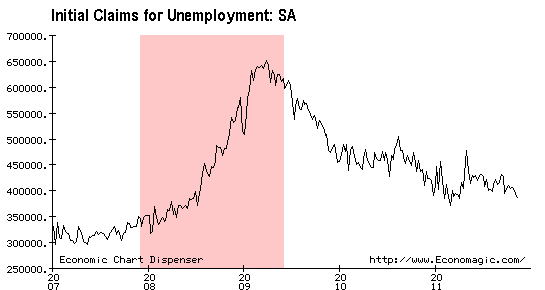
Now we have to make a more meaningful impact on the continuing claims series.
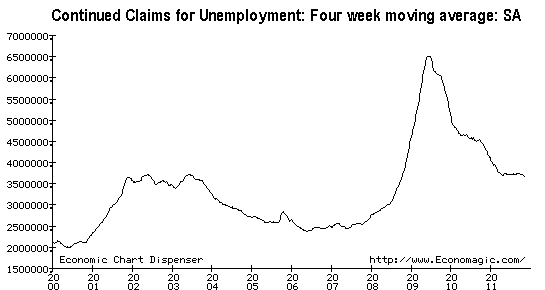
All in all, I think this should be taken as a modestly positive sign for the US economy. Absent the problems in Europe, Treasuriy prices should drift lower (higher yields) given the firming employment picture. Unfortunately, we can't invest "absent the turmoil in Europe" so it is still too early to set a short in UST. This may, however, reinforce the premise that corporate America is solid credit iis still a decent play (the equity market is dictated by the European whack-a-mole).
November 16, 2011 Corporate Bond Issuance
Corporate issuance slowed today from its breakneck pace.

I personally think there is some value remaining in corporates as the credit risk premium is still attractive (not fat and juicy attractive, but attractive nonetheless).

I personally think there is some value remaining in corporates as the credit risk premium is still attractive (not fat and juicy attractive, but attractive nonetheless).
Wednesday, November 16, 2011
November 16 Market Review
Another day of the "de-risking" trade. Anyone else getting tired of the "Europe has a plan!", "Europe has no plan" volatility. Lets cut straight to the point - there is no possible plan! Brushing aside for the moment the constitutional crisis enveloping the continent, what we have is a downward spiraling ecosystem. Debt piled on when times were good (and a haughty wink-wink, nod-nod by the EU regarding debt levels) turned to lead as the system slowed. In order to tame the beast, austerity measures are bantered about which are growth killers (not to mention they get in the way of the mountain of entitlements the populace is used to) and result in higher relative debt/GDP ratios for the foreseeable future. The populace chokes, governments collapse and the sovereign crisis continues. Then comes the good part - the crisis spreads (probably a poor choice of words, I will admit) to the banking sector (poor choice because it has always been in the banking sector as well) which compounds the problem, further retards growth and ushers in a "new 2008" crisis. Good stuff, no? Yeah, just wait until we address the capital shenanigans the Eurobanks like to play with risk, risk models and risk management (recall what AIGFP was used for - removing capital hogs from Eurobank balance sheets).
In any event, enough of my discourse, what the hell did we see out there today:
Equities:


In any event, enough of my discourse, what the hell did we see out there today:
Equities:

After grinding back up from an out of the gate drop, Fitch come out with a report on US banks and their exposure to Europe. Some snippets:
Contagion Effects Potentially Large: U.S. banks could be greatly affected if contagion continues to spread beyond the stressed European markets (Greece, Ireland, Italy, Portugal, and Spain). Exposures to large European countries and banks are sizable. The ongoing economic and market effects are additional concerns. The crisis has been negatively affecting European credit profiles and has resulted in numerous rating actions recently.

Report here: 11-16 Fitch
Net exposure. Gotta love it. Ummmm, what happens when exchanges are voluntary and 50% of your holding is wiped out without triggering your insurance policy.... Yup, net is gross. Honestly, is this news?
Wednesday, September 28, 2011
Gundlach on Corporates
Interesting article on Bloomberg:
Full article can be found here: Gundlach - Bonds
While I believe that the economy isn't as rosy as statistics might show, I do not expect defaults (ex-sovereign) to increase significantly and corporate balance sheets are in decent shape (although they could begin to erode should equity prices remain at current levels or go lower as the WACC will be reduced be the issuance of debt) which should help protect against a spike in defaults.
I also believe that the European issues (no, not just Greece which is the tip of the iceberg) present investors with some opportunities as the babies are going out with the bathwater.
In my opinion, 6B and 5B corporate debt is still attractive at these levels (relative spreads as they are the indication of a risk premium relative to the risk-free rate) and continues to warrant an overweight position. There has also been some interesting preferred stock and "baby bond" issues lately that offer attractive yields.
Happy Wednesday.
Mike
Gundlach Has No Europe Bets, Likes Corporates
Excerpts:
Jeffrey Gundlach’s DoubleLine Capital LP is invested only in U.S. dollar-denominated assets in a bid to avoid losses stemming from Europe’s debt crisis.
“All of our international exposure is in dollars,” Gundlach, the founder and head of Los Angeles-based DoubleLine, said at a panel sponsored by the firm in New York today. “There’s a big loss in Europe and all we want to do as investors is make sure as best we can that we’re not the ones taking the loss. How do you do it? No investments in Europe.”
DoubleLine is also avoiding U.S. banks because of possible exposure to the crisis and favors investment-grade corporate debt because defaults may rise in lower-rated bonds next year. Gundlach, who managed the top-rated intermediate-term U.S. bond mutual fund for 15 years, began cutting exposure to junk bonds in the fourth quarter of 2010, even as Bank of America Corp. and Goldman Sachs Group Inc. strategists forecast the riskiest debt to return as much as 10 percent this year.
“Investment-grade corporate bonds have done very well,” said Gundlach, who has attracted $17 billion in assets since founding DoubleLine in December 2009. “The investment-grade bonds DoubleLine holds had a bad August with all risk assets, but prices are nearing their highs. It’s a totally different story in below investment-grade, where we see the market really has collapsed.”
“I like junk bonds a lot better than I did six months ago, but I am not ready to buy them yet,” he said. “The high yield bond market is going to have a default problem in late 2012 or 2013.”
Moody’s Investors Service forecast the speculative-grade default rate will “remain low” at 2.2 percent a year from now, compared with 2.1 percent in August, according to a Sept. 22 statement. That compares with a peak of 14.5 percent amid the credit crisis in November 2009.
“We’re not going to be ready to jump back in to high yield basically until Greece is solved,” said Bonnie Baha, head of DoubleLine’s global developed credit group.
Full article can be found here: Gundlach - Bonds
While I believe that the economy isn't as rosy as statistics might show, I do not expect defaults (ex-sovereign) to increase significantly and corporate balance sheets are in decent shape (although they could begin to erode should equity prices remain at current levels or go lower as the WACC will be reduced be the issuance of debt) which should help protect against a spike in defaults.
I also believe that the European issues (no, not just Greece which is the tip of the iceberg) present investors with some opportunities as the babies are going out with the bathwater.
In my opinion, 6B and 5B corporate debt is still attractive at these levels (relative spreads as they are the indication of a risk premium relative to the risk-free rate) and continues to warrant an overweight position. There has also been some interesting preferred stock and "baby bond" issues lately that offer attractive yields.
Happy Wednesday.
Mike
Thursday, September 8, 2011
Corporate Issuance Update
Busy couple of days on the new issue front as issuers look to take advantage of lower benchmark yields. Yesterdays issuance consisted of:
Time Warner Cable (Baa2/BBB) - $1B 10yr, $1.25B 30yr. +210/232 respectively
Heinz (baa2/BBB+) - $300MM 5yr, $400MM 10yr. +110/125 respectively
Schlumberger Norge (A1/A+) $500MM 5yr +108
Schlumberger Lux (A1/A+) $600MM 5yr, $1.6B 10yr. +108/130 respectively
Wisc Elec (A2/A) $300MM 10yr +105
Daimler Finance (A3/BBB+) $800MM 3y, $1.5B 5y, $750MM 10y. +165/185/195 respectively
Xcel Energy (Baa1/BBB+) $250MM 30yr +150
France Telecom (A3/A) $1B 5yr, $1B 10yr. +195/220 respectively
Pac Gas (A3/BBB+) $250MM 10yr +130
Would expect issuers to continue to step in at these levels. While absolute yields are low, corporate spreads are still attractive relative to alternatives - especially given the current strength of corporate balance sheets and the risk premium relative to absolute yields.
Time Warner Cable (Baa2/BBB) - $1B 10yr, $1.25B 30yr. +210/232 respectively
Heinz (baa2/BBB+) - $300MM 5yr, $400MM 10yr. +110/125 respectively
Schlumberger Norge (A1/A+) $500MM 5yr +108
Schlumberger Lux (A1/A+) $600MM 5yr, $1.6B 10yr. +108/130 respectively
Wisc Elec (A2/A) $300MM 10yr +105
Daimler Finance (A3/BBB+) $800MM 3y, $1.5B 5y, $750MM 10y. +165/185/195 respectively
Xcel Energy (Baa1/BBB+) $250MM 30yr +150
France Telecom (A3/A) $1B 5yr, $1B 10yr. +195/220 respectively
Pac Gas (A3/BBB+) $250MM 10yr +130
Would expect issuers to continue to step in at these levels. While absolute yields are low, corporate spreads are still attractive relative to alternatives - especially given the current strength of corporate balance sheets and the risk premium relative to absolute yields.
Tuesday, July 5, 2011
WTO to China - They're not THAT Rare!
On the wire (NYT):
BRUSSELS — In a dispute that highlights growing tension between China and its Western trading partners, the World Trade Organization ruled Tuesday that Beijing violated global rules by restricting exports of nine raw materials used in the manufacturing of high technology products.
The case, lodged by the United States, the European Union and Mexico, dates from 2009 and underlines the anxiety in the West about the way China is consolidating its trading dominance.
Significantly, the ruling strengthens other European arguments against Chinese restrictions on another category of exports — rare earths, 17 minerals also used in the high-tech industry. However the case also demonstrates how dependent technology industries have become on some exports from China.
The W.T.O. panel rejected China’s argument that its restrictions were motivated by a desire to protect the environment and prevent a critical shortage of the materials.
The decision on Tuesday concluded that Chinese quotas, export duties and license requirements put in place a discriminatory system for the sale overseas of industrial raw materials widely used in the steel, aluminum and chemicals industries, including coke, zinc and bauxite.
“This is a clear verdict for open trade and fair access to raw material,” Karel De Gucht, the European trade commissioner, said in a statement. “ Furthermore, in the light of this result, China should ensure free and fair access to rare earth supplies,” he added.
The E.U. quota of Chinese raw earth elements declined to 30,000 tons in 2010 from around 50,000 tons in 2009, according to an E.U. official who was not authorized to speak publicly.
The U.S. trade representative, Ron Kirk, called the W.T.O. decision on the raw materials “a significant victory for manufacturers and workers in the United States and the rest of the world.”
“China’s extensive use of export restraints for protectionist economic gain is deeply troubling,” Mr. Kirk added in a statement. “China’s policies provide substantial competitive advantages for downstream Chinese industries at the expense of non-Chinese users of these materials. They have also caused massive distortions and harmful disruptions in supply chains throughout the global marketplace”
Americans and Europeans had challenged China’s environmental protection argument by pointing out that the raw material consumption was not being controlled domestically.
China must now either appeal the ruling or comply with it. If it fails to do so the United States, Europe and Mexico could eventually be allowed to respond with equivalent trade sanctions.
In a statement issued by its mission to the W.T.O. in Geneva, China said “that although these measures have certain impact on domestic and international users, they are in line with the objective of sustainable development promoted by the W.T.O. and they help to induce the resource industry toward healthy development.”
The nine raw materials covered by the ruling on Tuesday are used in medicines, CDs, electronics, the automotive industry, ceramics, refrigerators and batteries among other products.
Of all the E.U. imports of some categories of magnesium, 95 percent are sourced in China, as is 91 percent of imports of some categories of manganese while almost 30 percent of E.U. phosphorous imports are Chinese.
European officials say the export restrictions increased the global price for the raw materials, and gave Chinese companies a clear commercial advantage which, in effect, constitutes a hidden subsidy. They also made it harder for non-Chinese companies to source the raw materials by making them less readily available on the global market.
The impact can be to increase the price of some products by as much as 100 percent, according to E.U. officials.
The ruling was welcomed by BusinessEurope, the lobbying group. “The W.T.O. panel decision clearly stipulates that almost all export duties and restrictions imposed by China are incompatible with W.T.O. rules,” it said in a statement. “If confirmed, this decision will require China to remove all unjustified restrictive measures on raw materials.”Certainly won't help the price of rare earth (not raw earth as stated in the article) companies which have been getting whacked over the last few sessions. That said, I will believe it when I see it.
Subscribe to:
Posts (Atom)