Showing posts with label Eurozone. Show all posts

Monday, January 16, 2012

Greece should just default

From the WSJ (article here: WSJ Greece 1-16:

Deadlocked Greek debt-rescheduling negotiations threaten to delay key talks for a critical bailout package set for early next week, with officials warning of a rising risk of default unless a breakthrough comes soon.
A senior delegation from the International Monetary Fund, the European Union and the European Central Bank are to arrive in Athens Friday to discuss Greece's second rescue program. Equally important is a meeting of European finance ministers in Brussels next Monday to formulate their portion of the next Greek bailout, set in October at €130 billion ($164.8 billion).

Both sets of talks hinge on Greece and its private-sector creditors reaching an initial agreement this week to reduce the country's debt to them by half. Talks were suspended Friday after disagreement over the rates of interest Athens would pay on Greek debt holdings. Attention is now focused on overtures to resume negotiations as early as Wednesday, according to Greek officials.
Talks between the Greek government and the Institute of International Finance, which represents the private creditors, broke down on Friday over the coupon on longer-term new bonds that Greece will issue in exchange for the old bonds held by the banks. The private sector wouldn't accept a coupon of 4% on the new bonds, much lower than expected.
The goal of the talks with the private sector is to slice €103 billion from the Greek government's €350 billion in debt without any signs of coercion. An agreement in principle would set up a formal debt offer during the week of Feb. 6-10, with the final debt exchange expected to be completed by the end of February.
The sticking point remains the interest rate stitched to the bond swap. Greece says it can't afford to pay more than a 4.5% average coupon on the new bonds, while sovereign creditors such as Germany and the IMF want below 4% to make sure Greece can afford it and to avoid future shortfalls. The IIF, however, wants more than 5%.
 Greece should just default.  Yes, it will be painful, yes the ramifications will ripple globally, but this dog and pony show is not working.  The whole notion of gaming the CDS system by a "voluntary" swap ultimately will not work.  Add to this the notion that austerity will help and what you have is a recipe for ultimate failure.

Wednesday, January 11, 2012

The Safety Dance and Negative Yields

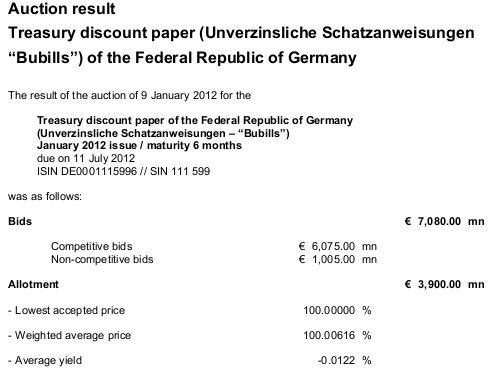
How scared are investors today when dealing with bonds?  Take a look at the following excerpt from the Bundesbank's 1/9 6 month bill release:


Full release here (http://www.bundesbank.de/download/presse/pressenotizen/2012/20120109.tenderergebnis.en.pdf).

Well, fear is great enough to justify paying Germany for the safety of your money for six months.  This is the first time that Germany has auctioned discount paper at a premium (not the first time discount paper has traded at a premium).  But everything is getting better in Europe, right?

Wednesday, January 4, 2012

Spain Thinking Bailout?

Marketwatch:

The losses come as Spanish newspaper Expansion reported that the Spanish government was mulling whether to apply for loans from the European Union's bailout fund and the International Monetary Fund to help restructure the nation's banks. The unconfirmed Expansion report cited unnamed sources, according to Bloomberg. "Unidentified officials were quoted in the piece, but there is no smoke without fire when it comes to the euro-zone sovereign debt crisis, and surely this suggests that the highest echelons of the Spanish government are toying with the idea that a bailout might be the best route forward," said Kathleen Brooks, research director at Forex.com, in a note.
Sigh, broken record...broken record...broken record.

Friday, November 18, 2011

Europe - Nighttime in the Switching Yard

Once again (or better yet, still) all eyes are focused on Europe.  My take:


Europe's financial situation (sovereign and banks) is a trainwreck.  There is no solution for the situation.  It is too big, resources are too thin and political/economic idealogies are to far apart.

This morning the Daily Telegraph released a document sourced from the German government with suggestions for an EU treaty change.  Contained within it:
The establishment of a procedure for an orderly default as part of the ESM:
For member states that are covered by an ESM programme, but despite complying with it are unable to achieve debt sustainability, the possibility of budgetary interventions is not sufficient. Therefore, there must also be the option of an orderly default in order to reduce the burden on taxpayers ( in the other eurozone states), and also to provide the affected country with an opportunity for a fresh start.  In the present ESM Treaty the possible participation by private creditors through socalled "collective action clauses” (CACs) is not sufficient.
The ESM should consider the request made by a member state for relief loans against the criteria of debt sustainability. If this is negative, the affected member state would instead receive loans for a limited time only, during which the procedure for an orderly default would be prepared.
In order to make sovereign defaults possible where they are unavoidable, the threat of instability in the financial system resulting from such a default must be able to be credibly excluded. A plan to maintain the stability of the financial system in the event of an orderly default needs to be developed in close co-operation with European banking regulators. This would determine which banks would be restructured and/or recapitalised, which will necessitate the drawing up of Europewide rules on bank restructuring.

Document here:  s3.documentcloud.org/documents/267781/brusselsembed.pdf

Germany sees the writing on the wall - sovereign defaults and the recapitalization of the banks.  Prepare for the worst and hope for the best.  It is not time to enter the fray with value eyes for there is only a value trap waiting.  Liquidity is non-existant, buyers are gone and there is no plan.  Continue to avoid European issues.

Thursday, November 17, 2011

Yield Pain in Spain

Ay, que es un alto rendimiento

The Spanish Treasury Thursday paid the highest yield on a 10-year government bond at auction since the inception of the euro but garnered enough demand to sell EUR3.563 billion of the bonds (the plan was EUR4 bil). The maximum yield paid for the 10-year bond, which matures January 2022, was 7.088%, a euro-era high.

Wednesday, November 16, 2011

November 16 Market Review

Another day of the "de-risking" trade.  Anyone else getting tired of the "Europe has a plan!", "Europe has no plan" volatility.  Lets cut straight to the point - there is no possible plan!  Brushing aside for the moment the constitutional crisis enveloping the continent, what we have is a downward spiraling ecosystem.  Debt piled on when times were good (and a haughty wink-wink, nod-nod by the EU regarding debt levels) turned to lead as the system slowed.  In order to tame the beast, austerity measures are bantered about which are growth killers (not to mention they get in the way of the mountain of entitlements the populace is used to) and result in higher relative debt/GDP ratios for the foreseeable future.  The populace chokes, governments collapse and the sovereign crisis continues.  Then comes the good part - the crisis spreads (probably a poor choice of words, I will admit) to the banking sector (poor choice because it has always been in the banking sector as well) which compounds the problem, further retards growth and ushers in a "new 2008" crisis.  Good stuff, no?  Yeah, just wait until we address the capital shenanigans the Eurobanks like to play with risk, risk models and risk management (recall what AIGFP was used for - removing capital hogs from Eurobank balance sheets).

In any event, enough of my discourse, what the hell did we see out there today:

Equities:


After grinding back up from an out of the gate drop, Fitch come out with a report on US banks and their exposure to Europe.  Some snippets:
Contagion Effects Potentially Large: U.S. banks could be greatly affected if contagion continues to spread beyond the stressed European markets (Greece, Ireland, Italy, Portugal, and Spain). Exposures to large European countries and banks are sizable. The ongoing economic and market effects are additional concerns. The crisis has been negatively affecting European credit profiles and has resulted in numerous rating actions recently.

Report here:  11-16 Fitch

Net exposure.  Gotta love it.  Ummmm, what happens when exchanges are voluntary and 50% of your holding is wiped out without triggering your insurance policy....  Yup, net is gross.  Honestly, is this news?

Tuesday, November 23, 2010

Portugal - Strike 'Em if Ya Got 'Em

Reuters:
Portugal's two biggest unions hold their first joint general strike since 1988 on Wednesday, hoping to weaken the Socialist government's resolve on implementing austerity measures meant to tackle a debt crisis.
Unions plan to stop trains and buses, ground planes and halt services from healthcare to banking in protest against wage cuts and rising unemployment in western Europe's poorest country.
Prime Minister Jose Socrates, whose government is struggling to quash speculation that Portugal will be the next in Europe to need a bailout after Ireland and Greece, has pledged to stay the course on wage cuts and tax hikes to cut the budget deficit.
"Maybe the strike will not provoke radical changes in the austerity course the government has chosen, but it does represent an addditional element of uncertainty in the already unstable setting in the country," said Elisio Estanque, a sociology researcher at the University of Coimbra.
The unions hope to tap into the growing disatisfaction with the minority Socialist government's austerity measures, which also include across the board spending cuts in public services.
 Greece did the same thing - it didn't work there, but Portugal seems unwilling to recognize the issues and challenges they face.  The Eurozone is still scary (yeah, worry far more about this than North Korea - boots on the ground in South Korea are not overly worried) and I would not yet be a player in Portugal (fewer corporate names anyway).  Portugal will be the focus of specs even sooner than I thought.

Global Bond Managers Euro Thoughts

From MoneyMarketing:

At least seven global bond funds revealed top 10 holdings in peripheral eurozone debt at the end of September, according to Trustnet, as Ireland’s financial woes accelerated towards its recent bailout.  Italy and Spain dominated the holdings, rather than Greece and Ireland, which have received a bailout from the IMF and the European Union - in Ireland’s case, the European Financial Stability Fund.
Managers also avoided Portugal, which has a deficit of almost 10 per cent of GDP and is struggling to pass budget cuts. 

Large portfolios which hold Spanish or Italian debt include the £753m Newton International Bond, the £423m F&C Global Bond, the £339.2m Threadneedle Global Bond, the £337m Old Mutual Global Strategic Bond and the £199m Henderson Overseas Bond funds.


Overall, Paul Brain, the manager of the Newton International Bond fund, says Spain is not growing fast enough to stomach the budget cuts required. He has sold out of Spanish debt entirely.
Dave Chappell and Martin Harvey, who co-manage the Threadneedle Global Bond fund, say the Italian situation looks somewhat superior. Like Brain, they have stuck with their holdings in the country.
Full article here:  Money Marketing on Global managers

Personally, It looks as if current Irish bank debt might be a better home (NOT SUB) as they will be receiving bailout funds (while there still are some) and we should see a "grandfathering" of the risk sharing (bail-in) that is being bantered about everywhere.  If this is the case, IRE might be worth a look.

Euro Comment

Saw this comment on the FT Alphaville.  Thought it was poignant (emphasis mine):

Spain CDS spreads will be 500bps unless we have a federal states of europe in pretty quick measure (which will not happen!)
Those with the privilege of having $ will just pick off the Euro countries one by one.
People have always said do not fight the fed, I have never heard someone saying "don't fight the ECB" 

As an aside:  Portugal also came out and said they will need NO money.  Always a bad sign when companies or countries try too hard to quell fear. 

Tuesday, November 16, 2010

Matthew Lynn on the Euro

I like Matthew Lynn.  Smart and witty - two things I aspire to.  Here are some excerpts of his thoughts on the Euro (it may seem like I am too focused on this, but I disagree - we are all currency traders now - and its my darn blog):

Who’s next? First Greece went bust. Now Ireland is on the brink of a bailout from the European Union and the International Monetary Fund.
When it happens, we’ll hear plenty of soothing words about how contagion has been stopped, the euro area has been put on a firmer footing, and the single currency saved. There will be a lot of grand rhetoric about the importance of the European project. Stern condemnations of the speculators will ring out across the continent.
Don’t listen to a word of it. The euro has turned into a bankruptcy machine. Once the markets have finished with Ireland, they will simply move on to Portugal and Spain, and after that to Italy and France.
In short, the problem wasn’t Ireland. It was the euro. The logic of that is inescapable. If it is the single currency that is at the root of the crisis, it won’t stop here. 
In each country, it will be a different trigger that causes a collapse in financial confidence. The root cause is the same, though. When the euro was launched, it was a big bet that sharing the same currency would make a group of very different economies converge, and so allow the European Central Bank to operate a single monetary policy for all of them.
It was an interesting theory, but it turned out to be wrong. The economies are just too different to allow a single central bank to manage all of them. Interest rates are always wrong everywhere. How that expresses itself varies. In Greece, it was a fiscal crisis. In Ireland, a banking collapse. In Spain, a construction bubble that burst. In Germany, a massive trade surplus. But, like a river looking for the sea, it always comes out somewhere.
This crisis will keep moving from country to country. The only permanent fix is splitting up the euro into more manageable currency areas. Until the euro area’s leaders recognize that simple truth, every bailout they come up with is only going to shift the attacks elsewhere.
The rest of the article is here:  Lynn on the Euro

As I am not as witty or smart (according to some, I couldn't possibly understand their 7th grade math, what with all the advances in math in the last 20 years), I will leave it at that.

Europe - Dark Days II Offers Opportunity

One of my favorite lines recently is "We are all currency traders now".  As we roll through the newest Euro-trouble, perhaps it is wise to see what has happened since the last european "issue", namely Greece.

Since the bottoming of the Euro on June 8th, the S&P is up 12% and S&P midcap growth is up 18%.

Am I saying that this will happen again?  No, decidedly not, as better earnings and US QEx has helped propel the markets forward.  What I am trying to point out is that the recovery from "dark days I or DD1" has been robust.  I would expect that recovery from "dark days II or DD2" will be decent as well.

I am looking at the following positions to benefit from "DD2":
Long FXE
Long FEZ (wouldn't mind shorting SPY into this leg, but I am a "long only" guy)


I will be playing with tight stops as I expect Portugal will offer us a "DD3" opportunity.

Thoughts?

DISCLOSURE:  No positions as of writing.

Ireland - One Step Closer to the IMF

Washington Post:

Ireland's Prime Minister acknowledged Tuesday that the country has been all but shut out from further borrowing on world bond markets as European leaders continued crisis talks over a possible rescue for the heavily indebted nation.
"The cost of money is simply too high. We have to find further initiatives," Irish Prime Minister Brian Cowen told the Parliament in Dublin, opening the door for the first time on a possible international bailout. 
"The issue now is whether Ireland will pull the trigger; will they ask for aid. They can't be helped without that request," said one official, who would not speak for the record because of the sensitive nature of the negotiations. 

As I pointed out in an earlier post, EU troubles are now very localized as LIBOR has stayed firm during this most recent episode.  Ireland will have to accept funds (needed or not) in order to help stabilize the makets and lead the way for Portugal to tap should they need to.  If Ireland takes money for the banks, and can shore up their capital, it will go a long way to reducing the spread on sovereign debt.

Monday, November 15, 2010

PIIGS - Its Different Now

With all the talk about the European periphery and the blowout in spreads and crippled banks, I thought it might be a good idea to look at a snapshot of that long ago time when Europe was on fire (yep, six months ago):

Way back then, troubles were reflected through three month LIBOR.  No such case now.  Are the banks better?  No.  Are the sovereigns better?  Debatable. Troubles now are localized, which is better and more accurate.  The market is getting more rational and whacking those countries that deserve it and not smacking all of Europe.  This could create some opportunities in stronger country bonds (sovereign and corporate) and help identify where your risks are.

Friday, November 12, 2010

G20 Temporarily Relieves Ireland

Reuters:

Spreads between 10-year Irish bond yields and German benchmarks fell nearly 100 basis points, ending a fierce two-week bout of peripheral debt selling which has raised concerns about the stability of the currency zone and hammered the euro.

Pressure on Greece, Portugal and Spain also eased after a statement by France, Germany, Italy, Spain and Britain at a Group of 20 summit in Seoul confirmed holders of existing debt would not have to shoulder the costs of any near-term rescue.

"Whatever the debate within the euro area about the future permanent crisis resolution mechanism and the potential private sector involvement in that mechanism we are clear that this does not apply to any outstanding debt and any program under current instruments," the statement said.
Note the comment in my earlier post from Speigel.

Irish Prime Minister Brian Cowen criticized Germany for pushing the idea of asset value reductions, or "haircuts," for private bondholders in a future rescue mechanism that Berlin wants in place by 2013, when the currency bloc's temporary bailout facility expires.  "It hasn't been helpful," Cowen told the Irish Independent newspaper, referring to Germany's plan. "The consequence that the market has taken from it is to question the commitment to the repayment of debt."
Just thinking out loud, but isn't the repayment question a fair one?  You will note that everyone is on board with bank "bail-ins" but sovereign is untouchable?  How arrogant.  This, my friends, remains to be seen.

Speigel Interview with German Finance Minister Schauble

I was reading the Speigel Interview with the German Finance Minister Wolfgang Schauble (available here: Speigel - Schauble) and I wanted to post some comments I thought were interesting and relevant.

SPIEGEL: But the German economy benefits from the fact that German industry has focused primarily on foreign markets and wages have hardly gone up in years. The Americans see this as unfair.Schäuble: The German export successes are not the result of some sort of currency manipulation, but of the increased competitiveness of companies. The American growth model, on the other hand, is in a deep crisis. The United States lived on borrowed money for too long, inflating its financial sector unnecessarily and neglecting its small and mid-sized industrial companies. There are many reasons for America's problems, but they don't include German export surpluses.
Amen, brother.  The US fingerpointing serves no end but political ones, and the last I checked finances, when left to politics, suffers a severe fate.

SPIEGEL: Last week, the US Federal Reserve Bank decided to flood the economy with $600 billion in new money. Will this stimulate the economy as hoped?  Schäuble: I seriously doubt that it makes sense to pump unlimited amounts of money into the markets. There is no lack of liquidity in the US economy, which is why I don't recognize the economic argument behind this measure.
Okay, thought I was the only one confused by the Fed's actions.  Guess not.  Confused might be the wrong word - inability to swallow the logic is perhaps a better way to phrase it.
SPIEGEL: Sounds good. But first the measures will have to be approved by the individual governments, on the one hand. On the other hand, it's completely unclear what the participation of private investors will look like. Schäuble: We are in the process of working out the details within the German government and at the European level. It's already clear today that the new mechanism will not apply to old debt but only to new loans. I imagine that all bonds issued by euro countries will contain clauses in the future that specify exactly what happens to the claims of creditors in case of crisis.
Found this interesting.  I imagine it could look like something of the old Landesbank structure given the grandfathering of debt and, therefore, the implicit guarantees.  This would serve to bifurcate the debt after an adoption, with "old debt" trading tight to "new debt" and the possibility - in the event of a restructuring - of massive international legal arguments and cases.


About Me

A student of the markets that has held portfolio management, analysis and trading positions for over 15 years.