Showing posts with label EU. Show all posts

Wednesday, January 11, 2012

The Safety Dance and Negative Yields

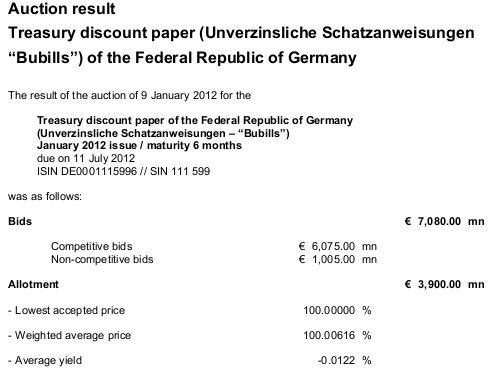
How scared are investors today when dealing with bonds?  Take a look at the following excerpt from the Bundesbank's 1/9 6 month bill release:


Full release here (http://www.bundesbank.de/download/presse/pressenotizen/2012/20120109.tenderergebnis.en.pdf).

Well, fear is great enough to justify paying Germany for the safety of your money for six months.  This is the first time that Germany has auctioned discount paper at a premium (not the first time discount paper has traded at a premium).  But everything is getting better in Europe, right?

Friday, November 18, 2011

Europe - Nighttime in the Switching Yard

Once again (or better yet, still) all eyes are focused on Europe.  My take:


Europe's financial situation (sovereign and banks) is a trainwreck.  There is no solution for the situation.  It is too big, resources are too thin and political/economic idealogies are to far apart.

This morning the Daily Telegraph released a document sourced from the German government with suggestions for an EU treaty change.  Contained within it:
The establishment of a procedure for an orderly default as part of the ESM:
For member states that are covered by an ESM programme, but despite complying with it are unable to achieve debt sustainability, the possibility of budgetary interventions is not sufficient. Therefore, there must also be the option of an orderly default in order to reduce the burden on taxpayers ( in the other eurozone states), and also to provide the affected country with an opportunity for a fresh start.  In the present ESM Treaty the possible participation by private creditors through socalled "collective action clauses” (CACs) is not sufficient.
The ESM should consider the request made by a member state for relief loans against the criteria of debt sustainability. If this is negative, the affected member state would instead receive loans for a limited time only, during which the procedure for an orderly default would be prepared.
In order to make sovereign defaults possible where they are unavoidable, the threat of instability in the financial system resulting from such a default must be able to be credibly excluded. A plan to maintain the stability of the financial system in the event of an orderly default needs to be developed in close co-operation with European banking regulators. This would determine which banks would be restructured and/or recapitalised, which will necessitate the drawing up of Europewide rules on bank restructuring.

Document here:  s3.documentcloud.org/documents/267781/brusselsembed.pdf

Germany sees the writing on the wall - sovereign defaults and the recapitalization of the banks.  Prepare for the worst and hope for the best.  It is not time to enter the fray with value eyes for there is only a value trap waiting.  Liquidity is non-existant, buyers are gone and there is no plan.  Continue to avoid European issues.

Friday, April 15, 2011

Greece - Sandy Beaches and Distressed Debt

Ahhh Greece, founder of democracy, philosophical masters, land of nice beaches good food and pretty women. Oh yeah, lets not forget fiscal austerity that stands no chance, land of the tax dodger and possibly debt restructurer.  Just wait for this one.  Its not like the country has no experience being in default, problem now is that its banks as well as European banks are gonna get whacked.


Greek 10 Year-Bund spreads just passed 1,000 for the first time ever and were last trading north. Following this statement from Germany's Hoyer, it seems all hell is about to break loose for peripheral spreads.

  • *GERMANY WOULD BACK VOLUNTARY GREEK RESTRUCTURING, HOYER SAYS
  • *GREEK DEFICIT CUTTING MAY NOT BE ENOUGH, HOYER SAYS
  • *GERMANY ‘WORRIED’ ABOUT GREEK FISCAL DEVELOPMENTS, HOYER SAYS
  • *GREEK DEBT RESTRUCTURING `WOULD NOT BE A DISASTER,' HOYER SAYS
  • *GERMAN EUROPE MINISTER HOYER SPEAKS IN INTERVIEW IN BERLIN
Rising Greek yields reflected disappointment that the government only presented the outline of fresh fiscal plans but left the details to be spelled out after Easter.

Don't think the Easter bunny is going to leave an egg the size of Wisconsin full of money folks.


It also outlined how it intends to raise 50 billion euros from privatisations by 2015, a target which many analysts and Greek politicians see as optimistic. It said it planned to promote real estate asset sales from October 2011.


How much for Rhodes?

Monday, January 10, 2011

Portugal - Dominoes are Tipping

More on Portugal from Reuters.  As I have been stating, a Portugese bailout is all but done.  I found the comments from Spain somewhat amusing as they have the most to prove and the most to lose.  Another day in the trenches.


As much as it makes me fundamentally nauseous, long USD, short EUR, long UST, short beta.

The European Central Bank threw Portugal a temporary lifeline on Monday by buying up its bonds, traders said, as market and peer pressure mounted for Lisbon to seek an international bailout soon.
A senior euro zone source told Reuters on Sunday that Germany, France and other euro zone countries were pushing Portugal to seek an EU-IMF assistance program, following Greece and Ireland, in a bid to prevent contagion spreading to much larger Spain, the fourth biggest economy in the euro area.
The interest rate premium on Portuguese sovereign debt fell on Monday after rising sharply late last week as traders said the ECB intervened to buy government bonds on the secondary market.
"They're buying five-years and 10-years in Portugal, whatever people are offering really," one trader said.
Another trader said the ECB appeared to be buying Greek and Irish bonds too. EU sources say the central bank has not yet bought Spanish government debt.
Spanish Economy Minister Elena Salgado said Portugal did not need to apply for aid because it was meeting its commitments to reduce its budget deficit. And the European Commission said no discussion was currently under way on assistance for Portugal or any other country. Spain knows it is next!

Tuesday, December 21, 2010

Ireland - Which Way is Up?

Ah, the daily grind of trying to interpret just how screwed Europe is.  Forget another warning on Greek debt, forget shots across Portugal's bow, forget increased funding costs for Spain - lets just address (for the time being) the luck 'o the Irish.


Headlines ripping across saying the ECB has warned that junior creditors will be eating losses on AIB sub debt (except them, of course as sub debt has been used for loan collateral).  Then, a little while later we see a story that Ireland's desire to force pain on junior creditors might be unconstitutional.


Confused?  So am I.  Houston, we've got a problem here.  If the banks are, essentially, insolvent, junior creditors should get hit.  Ireland wants to ensure they will.  Problem number one is that the ECB will get hit too.  See, if your collateral for loans gets whacked, there has to be a margin call.  Who in Europe is going to pony that one up?  Second problem is the whole notion of constitutional.  No problem here, we (the US) subverted our constitution when the govt (administrative branch) stole GM and Chrysler from creditors, essentially creating a sub-rosa bankruptcy plan (I wrote on that a long time ago here: chrysler-a-sub-rosa-by-any-other-name).  Constitution, we don't need no stinking constitution.   


Bottom line: Its going to be interesting and the WHOLE Euro region is going to continue to come under pressure in debt and currency markets.  I would sideline here, maybe look for cheap - but solid - debt and equity stories, for high beta, maybe some T1 or LT2 debt.


(Reuters) Ireland risked a fresh complication to radical plans to overhaul its financial sector on Tuesday with a controversial new banking law facing a possible constitutional veto by the country's top court.
The legislation gives the state wide-ranging powers to restructure the banking industry as part of an 85 billion euros ($112 billion) EU/IMF bailout package.
But its scope has raised objections from the European Central Bank (ECB) and opposition politicians, who warned it will make Finance Minister Brian Lenihan a "one-man legislature.
President Mary McAleese has held off signing the bill into law amid until she hears advice about its constitutionality on Tuesday from the Council of State, a panel of top political figures including the prime minister, attorney general and High Court President.
She will then decide whether to ask the Supreme Court to rule if the law or parts of it is constitutional, a move which could delay plans by government for junior creditors in Irish banks to swallow losses on their investments.
Her decision is expected later on Tuesday or Wednesday. The cut-off date for her to either sign the bill or send it to the court is Thursday.
But today we also read (again from Reuters):
Allied Irish Banks' junior bondholders will have to take a big hit in a future restructuring, the European Commission warned on Tuesday as it rubber-stamped billions of euros in state aid for Irish banks.
Brussels' threat triggered a fall in Irish sovereign debt, stoking fears the continuing financial crisis means more pain, including the spectre of forced discounts for investors, despite an 85 billion euro ($112 billion) EU/IMF bailout. 

Tuesday, December 7, 2010

PIIGS Update - Spreads Muted

Spreads in the periphery are somewhat muted today as a result of official buying in Portugal, Ireland and Greece.


Periphery: yield vs GER lvls (chg on day) in bps
              2y         5y        10y       30y/15y for IRE
ESP    247 (+7)   271 (+11) 235 (+4)  261 (+2)
POR    301 (-3)   309 (+2)  309 (+0)  295 (-2)
GRE  1068 (+16) 1067 (+7) 879 (0)   566 (-4)
IRE    400 (-3)   497 (-10) 523 (-11) 476 (-15)
ITA    158 (-2)   169 (+2)  166 (+3)  194 (0)


Hearing real money selling into official buying.

Tuesday, November 23, 2010

Euro Comment

Saw this comment on the FT Alphaville.  Thought it was poignant (emphasis mine):

Spain CDS spreads will be 500bps unless we have a federal states of europe in pretty quick measure (which will not happen!)
Those with the privilege of having $ will just pick off the Euro countries one by one.
People have always said do not fight the fed, I have never heard someone saying "don't fight the ECB" 

As an aside:  Portugal also came out and said they will need NO money.  Always a bad sign when companies or countries try too hard to quell fear. 

Sunday, November 21, 2010

Ireland Formally requests Aid

Reuters:

The EU and IMF agreed on Sunday to help bail out Ireland with loans to tackle its banking and budget crisis in a bid to protect Europe's financial stability.

Ireland, facing widespread public anger over its handling of the crisis, formally requested the aid on Sunday evening.

"The European authorities have agreed to our request," Prime Minister Brian Cowen said. "I expect that agreement to be finalised shortly, within the next few weeks."

The size of the rescue by the European Union and the International Monetary Fund has yet to be negotiated but is likely to be smaller than Greece's 110 billion euro ($150 billion) bailout last May.

"I would say we are talking about 80-90 billion euros," a senior EU source said, adding that this sum would include money to support the Irish banking sector.

EU Economic and Monetary Affairs Commissioner Olli Rehn said the European Commission, European Central Bank and IMF would prepare a three-year package of loans by the end of the month.

"Providing assistance to Ireland is warranted to safeguard the financial stability in Europe," Rehn told Reuters.

"The programme under preparation will address both the fiscal challenges of the Irish economy and the potential future capital needs of the banking sector in a decisive manner."

Britain, which is not part of the euro zone, said it would offer some 7 billion pounds ($11.19 billion) in bilateral aid.

Irish Banks should trade higher, the Euro is trading higher, Stoxx should trade higher.  FEZ still has room to go, but monitor closely as people turn their attention to Portugal.  Recall earlier post on Dark Days II and III.

Friday, November 12, 2010

Speigel Interview with German Finance Minister Schauble

I was reading the Speigel Interview with the German Finance Minister Wolfgang Schauble (available here: Speigel - Schauble) and I wanted to post some comments I thought were interesting and relevant.

SPIEGEL: But the German economy benefits from the fact that German industry has focused primarily on foreign markets and wages have hardly gone up in years. The Americans see this as unfair.Schäuble: The German export successes are not the result of some sort of currency manipulation, but of the increased competitiveness of companies. The American growth model, on the other hand, is in a deep crisis. The United States lived on borrowed money for too long, inflating its financial sector unnecessarily and neglecting its small and mid-sized industrial companies. There are many reasons for America's problems, but they don't include German export surpluses.
Amen, brother.  The US fingerpointing serves no end but political ones, and the last I checked finances, when left to politics, suffers a severe fate.

SPIEGEL: Last week, the US Federal Reserve Bank decided to flood the economy with $600 billion in new money. Will this stimulate the economy as hoped?  Schäuble: I seriously doubt that it makes sense to pump unlimited amounts of money into the markets. There is no lack of liquidity in the US economy, which is why I don't recognize the economic argument behind this measure.
Okay, thought I was the only one confused by the Fed's actions.  Guess not.  Confused might be the wrong word - inability to swallow the logic is perhaps a better way to phrase it.
SPIEGEL: Sounds good. But first the measures will have to be approved by the individual governments, on the one hand. On the other hand, it's completely unclear what the participation of private investors will look like. Schäuble: We are in the process of working out the details within the German government and at the European level. It's already clear today that the new mechanism will not apply to old debt but only to new loans. I imagine that all bonds issued by euro countries will contain clauses in the future that specify exactly what happens to the claims of creditors in case of crisis.
Found this interesting.  I imagine it could look like something of the old Landesbank structure given the grandfathering of debt and, therefore, the implicit guarantees.  This would serve to bifurcate the debt after an adoption, with "old debt" trading tight to "new debt" and the possibility - in the event of a restructuring - of massive international legal arguments and cases.


Tuesday, November 9, 2010

ECB Buying Govt Debt Again

ECB forced to act as crisis fears rise (FT) The ECB said it spent €711m ($991m) buying government debt last week, reactivating an emergency program that had lain dormant in the previous three weeks. That almost certainly understated significantly the scale of its actions, with purchases late in the week still to feed into the published figures. Its latest intervention pointed to mounting ECB concern, but last week’s bond purchases were still small in comparison with the €64bn ($89bn) spent since May, when the programme was launched at the height of the crisis over eurozone public finances. Jean-Claude Trichet, president, has said the ECB programme was aimed simply at ensuring the correct functioning of markets. Axel Weber, Germany’s Bundesbank president, has voiced public opposition to even the current program, which he fears is creating inflation risks.


Not over - not by along shot.  I still expect increased talk of an orderly restructuring.  I am not sure it will happen, but chances are above 50%.  Still very shy of the Euro.

Wednesday, November 3, 2010

Europe - Sovereign Flare Up? No, Just Back in the Press

From BenZinga:

It would appear that sovereign debt concerns in Europe are beginning to push themselves back into the forefront. Investors are dumping both Irish and Greek bonds, driving yields and CDS premiums to near record levels.
Yesterday, Irish credit costs hit a record high as bonds fell after the resignation of Jim McDaid, a member of parliament for Ireland's Fianna Fail party. The resignation added to concerns that the government would fail to muster the votes for planned spending cuts and tax hikes.
“Investors are worried about political factions coming into agreement about getting fiscal policy back on track,” said Andrew Wilkinson, senior market analyst for Interactive Brokers.
Despite higher yields and rising CDS premiums on Irish and Greek debt, the Euro has been holding up quite well. Six months ago, when the EuroZone crisis was in full swing, the Euro currency traded below $1.20. Currently, however, the EUR/USD is trading at $1.4015.
I would posit that they never went away.  The difference now is that I believe folks have determined that the EU will allow an "orderly" restructuring of sovereign debt.  Do they have a choice?  I have long maintained that with many of these governments, fiscal austerity will be promised - but delivered is another story.  The people will not change their ways because the government has told them to.  They have been through this many times (at least those countries most affected) and will simply run the ruling party out of town.  Euro might hold these levels, but I am not convinced.  Still like the commodity/rate currencies over the USD or EUR.

Thursday, October 14, 2010

Greece - Calls for a General Strike

Greece's main private sector union called a 24-hour strike against austerity for Dec. 15 to demand the government protects jobs and gives back pension benefits scrapped under an EU/IMF bailout plan.

"GSEE calls on all citizens to mobilise to defend basic and fundamental rights," the union, which represents about 2 million workers, said in a statement. "We send a message to all that workers have reached their tolerance limits and will not accept new cuts."

Best of luck with that.  How much better will you fare as a bankrupt nation?  You might be able to raise some $$$ by selling some islands to Turkey.

Monday, September 20, 2010

European Sovereign Risk - Going to Get Worse

From the WSJ:
The European Central Bank increased its purchases of government bonds last week amid rising concerns in financial markets about the ability of Greece, Ireland and Portugal to repay their debts.
Despite spending more than €61 billion ($79.58 billion) since May on government bonds, the ECB has failed to prevent yield spreads between government debt in Greece, Ireland and Portugal and their safer German equivalents from hitting or approaching record highs, making it harder for struggling countries on Europe's fringe to finance their mounting debt levels.
The latest increase in debt purchases "is an illustration that the sovereign-debt crisis is surfacing again, but it's not as severe as May," says Carsten Brzeski, economist at ING Bank in Brussels.
On Monday, yields spreads between Irish and German 10-year bonds—a key measure of investors' perception of the risk associated with Irish bonds—exceeded four percentage points, a record, and more than double the spread that existed on May 10 when the ECB started buying government debt.
Portuguese yield spreads also hit a record Monday, at more than four percentage points above safer German equivalents. That spread was just 1.89 percentage points on May 10, a sign, some analysts said, that the ECB hasn't been able to affect market sentiment. Greek spreads are near record highs at more than nine percentage points above German government bonds.

Personally I believe that sovereign risk in the EU is going to get worse as we enter the fall and austerity measures are going to be felt by the citizens of the country.  I am curious as to who is buying the government bonds - is it still the banks?  While yields on EU sovereign debt are attractive, I believe they will go higher.

About Me

A student of the markets that has held portfolio management, analysis and trading positions for over 15 years.